Oxford researchers awarded ARIA funding to develop an ‘Internet of Birds.’
University of Oxford researchers are to receive backing of a £500,000 grant from the Advanced Research + Invention Agency (ARIA) to develop advanced monitoring technologies that could be carried by wild birds. Ultimately, this could provide invaluable data to inform actions to restore nature and improve ecosystem resilience.

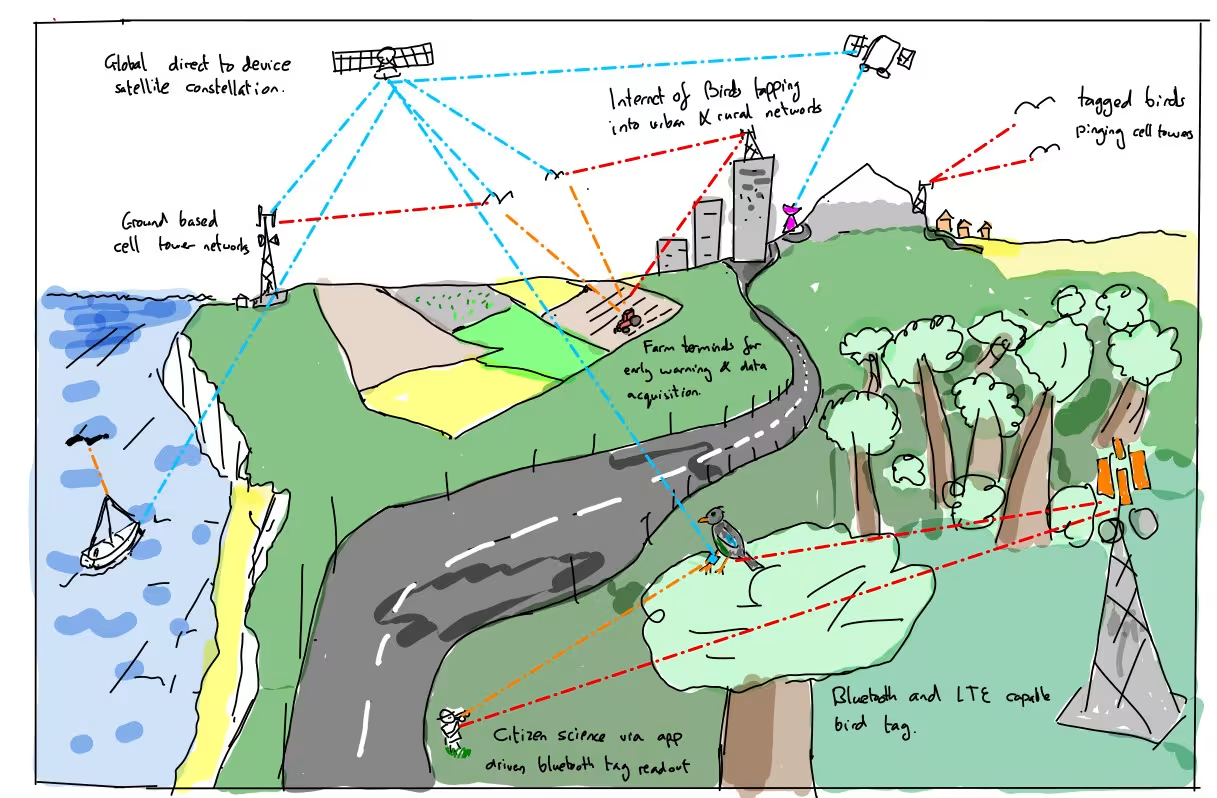
Oxford biologists and engineers are to lead a project to establish an ‘Internet of Birds.’ This aims to develop improved bird monitoring technologies in order to utilise wild birds as free-roaming deployable sensors. Image credit: Getty Images.

Established by the UK Parliament in January 2023 and sponsored by the Department for Science, Innovation and Technology, ARIA is an R&D funding agency created to unlock technological breakthroughs that benefit everyone. Their Engineering Ecosystem Resilience opportunity space is exploring how combining high-resolution measurement with targeted, resilience-boosting interventions could help reverse biodiversity decline and prevent ecological collapse.
As part of this work, biologists and engineers at Oxford are to lead an interdisciplinary project to establish an ‘Internet of Birds.’ This aims to develop improved bird monitoring technologies in order to utilise wild birds as free-roaming deployable sensors that actively sample their environment.
“We expect this technology to drive a sea-change in our understanding of bird ecology and conservation needs, enable targeted interventions to simultaneously protect birds and human energy infrastructure such as wind turbines and power lines, and allow improved prediction, prevention and mitigation strategies for bird-borne zoonotic diseases.”

Birds are critically important in nutrient cycling, pollination and seed dispersal, and also serve as valuable bioindicators for climate change, pollution, water quality and biodiversity. However, current bird monitoring methods have significant limitations in terms of spatio-temporal coverage, effort vs. data-return, and tag size, weight, cost and battery life.
The new project will develop bird leg rings that are small, light, inexpensive, solar powered and continuously globally tracked. This approach will reduce species size or tag cost restrictions and data bias due to location or timing of bird movement. The data could inform individual species conservation, environmental impact mitigation for infrastructure, zoonotic disease modelling, and interventions to halt biodiversity loss and protect ecosystem functions.
Co-project lead Associate Professor Chris Stevens (Department of Engineering Science) said: ‘Birds are among the most widely travelled animals on our planet and as such experience the good and bad aspects of its climate and ecology throughout their lives. If we could have a day-to-day record of a bird's movements, we would gain a fantastically rich set of data about both them and their environment.’
The project will harness the latest advancements in Internet of Things technologies, mobile telecommunications and extremely low power electronics. It will develop improved bird rings that are equipped with antenna to continuously report location data back to a server.

Co-project lead Dr Tonya Lander (Christ Church, University of Oxford) said: ‘‘The British Bird Ringing Scheme began in 1909, and birds have been tracked using a range of methods ever since. But since 2012 there have been a series of advances in digital data storage, internet technology and internet security that mean the time is now right for a new generation of bird trackers that will be small, light and inexpensive enough to replace traditional rings, but will provide regular, global location updates for the lifetime of the bird. We expect this technology to drive a sea-change in our understanding of bird ecology and conservation needs, enable targeted interventions to simultaneously protect birds and human energy infrastructure such as wind turbines and power lines, and allow improved prediction, prevention and mitigation strategies for bird-borne zoonotic diseases.’
Associate Professor Stevens added: ‘As an engineer, this project presents a fun challenge for an extremely worthwhile cause. Essentially, all of the key functions have to be packed into an object that is not much bigger than the last joint of your smallest finger, whilst requiring no charging and running for years without attention.’
This project is funded by ARIA within their Engineering Ecosystem Resilience opportunity space. Further information can be found on the ARIA website.
For more information about this story or republishing this content, please contact [email protected]